Ray William Johnson So Called Art Man With Pole
| Ray Bradbury | |
|---|---|
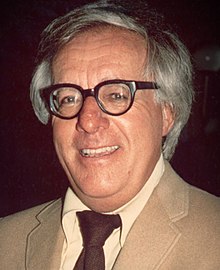 Bradbury in 1975 | |
| Born | Ray Douglas Bradbury (1920-08-22)August 22, 1920 Waukegan, Illinois, U.South. |
| Died | June five, 2012(2012-06-05) (aged 91) Los Angeles, California, U.S. |
| Resting place | Westwood Memorial Park, Westwood, Los Angeles |
| Occupation | Writer |
| Didactics | Los Angeles High School |
| Menses | 1938–2012[i] |
| Genre |
|
| Notable works |
|
| Notable awards |
|
| Spouse | Marguerite McClure (yard. 1947; died 2003) |
| Children | 4 |
| Signature |  |
| Website | |
| www | |
Ray Douglas Bradbury (; August 22, 1920 – June 5, 2012) was an American author and screenwriter. I of the most celebrated 20th-century American writers, he worked in a variety of modes, including fantasy, scientific discipline fiction, horror, mystery, and realistic fiction.[iii]
Bradbury was mainly known for his novel Fahrenheit 451 (1953) and his brusque-story collections The Martian Chronicles (1950) and The Illustrated Man (1951).[4] Most of his best known work is speculative fiction, but he as well worked in other genres, such every bit the coming of historic period novel Dandelion Wine (1957) and the fictionalized memoir Green Shadows, White Whale (1992). He also wrote and consulted on screenplays and boob tube scripts, including Moby Dick and It Came from Outer Space. Many of his works were adjusted into television and film productions also as comic books.
The New York Times called Bradbury "the writer most responsible for bringing mod science fiction into the literary mainstream."[4]
Early life [edit]
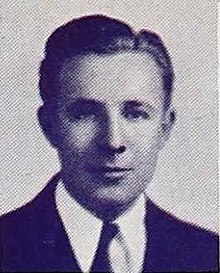
Bradbury equally a senior in high schoolhouse, 1938
Bradbury was built-in on August 22, 1920, in Waukegan, Illinois, to Esther (née Moberg) Bradbury (1888–1966), a Swedish immigrant, and Leonard Spaulding Bradbury (1890–1957), a power and telephone lineman of English ancestry.[5] [vi] [seven] [viii] He was given the center name "Douglas" after the actor Douglas Fairbanks.
Bradbury was surrounded by an extended family during his early childhood and determinative years in Waukegan. An aunt read him curt stories when he was a child.[9] This period provided foundations for both the author and his stories. In Bradbury's works of fiction, 1920s Waukegan becomes "Dark-green Town", Illinois.
The Bradbury family lived in Tucson, Arizona, during 1926–1927 and 1932–1933 while their male parent pursued employment, each time returning to Waukegan. While living in Tucson, Bradbury attended Amphi Junior High School and Roskruge Junior High School. They eventually settled in Los Angeles in 1934 when Bradbury was 14 years former. The family arrived with merely US$xl (equivalent to $810 in 2021), which paid for rent and food until his father finally plant a job making wire at a cable company for $14 a week (equivalent to $284 in 2021). This meant that they could stay, and Bradbury, who was in love with Hollywood, was ecstatic.[ citation needed ]
Bradbury attended Los Angeles Loftier School and was active in the drama social club. He often roller-skated through Hollywood in hopes of meeting celebrities. Amidst the creative and talented people Bradbury met were special-effects pioneer Ray Harryhausen and radio star George Burns. Bradbury's first pay as a writer, at historic period 14, was for a joke he sold to George Burns to use on the Burns and Allen radio show.[10] [11]
Influences [edit]
Literature [edit]
Throughout his youth, Bradbury was an avid reader and writer and knew at a young historic period that he was "going into one of the arts."[12] [13] Bradbury began writing his ain stories at age 12 (1931) —sometimes writing on butcher paper.[14]
In his youth, he spent much time in the Carnegie Library in Waukegan, reading such authors as H. Grand. Wells, Jules Verne, and Edgar Allan Poe. At 12, Bradbury began writing traditional horror stories and said he tried to imitate Poe until he was about eighteen.[15] In addition to comics, he loved the piece of work of Edgar Rice Burroughs, creator of Tarzan of the Apes, especially Burroughs' John Carter of Mars series. The Warlord of Mars impressed him so much that at the historic period of 12, he wrote his own sequel.[xvi] [17] The young Bradbury was also a cartoonist and loved to illustrate. He wrote virtually Tarzan and drew his ain Sunday panels. He listened to the radio testify Chandu the Magician, and every dark when the evidence went off the air, he would sit and write the unabridged script from memory.[18]
As a teen in Beverly Hills, he ofttimes visited his mentor and friend science-fiction author Bob Olsen, sharing ideas and maintaining contact. In 1936, at a secondhand bookstore in Hollywood, Bradbury discovered a handbill promoting meetings of the Los Angeles Scientific discipline Fiction Gild.[19] Excited to find that others shared his interest, Bradbury joined a weekly Th-night caucus at age xvi.[twenty]
Bradbury cited H. M. Wells and Jules Verne as his master science-fiction influences. Bradbury identified with Verne, saying, "He believes the human being is in a strange situation in a very foreign earth, and he believes that we can triumph past behaving morally". [21] Bradbury admitted that he stopped reading science-fiction books in his 20s and embraced a broad field of literature that included poets Alexander Pope and John Donne.[22] Bradbury had just graduated from high school when he met Robert Heinlein, then 31 years old. Bradbury recalled, "He was well known, and he wrote humanistic science fiction, which influenced me to dare to be human instead of mechanical."[22]
In young adulthood Bradbury read stories published in Astounding Science Fiction, and read everything by Robert A. Heinlein, Arthur C. Clarke, and the early writings of Theodore Sturgeon and A. Eastward. van Vogt.
Hollywood [edit]
The family lived nearly four blocks from the Fox Uptown Theatre on Western Avenue in Los Angeles, the flagship theater for MGM and Pull a fast one on. There, Bradbury learned how to sneak in and watched previews almost every week. He rollerskated at that place, also as all over town, every bit he put it, "hell-bent on getting autographs from glamorous stars. It was glorious." Among stars the young Bradbury was thrilled to encounter were Norma Shearer, Laurel and Hardy, and Ronald Colman. Sometimes, he spent all solar day in front end of Paramount Pictures or Columbia Pictures and and so skated to the Brown Derby to picket the stars who came and went for meals. He recounted seeing Cary Grant, Marlene Dietrich, and Mae West, who, he learned, made a regular advent every Friday night, babysitter in tow.[22]
Bradbury relates the post-obit meeting (as an adult) with Sergei Bondarchuk, director of Soviet ballsy pic serial War and Peace, at a Hollywood award ceremony in Bondarchuk'southward honor:
They formed a long queue and every bit Bondarchuk was walking along it he recognized several people: "Oh Mr. Ford, I like your film." He recognized the manager, Greta Garbo, and someone else. I was standing at the very end of the queue and silently watched this. Bondarchuk shouted to me; "Ray Bradbury, is that you?" He rushed up to me, embraced me, dragged me within, grabbed a bottle of Stolichnaya, sat down at his table where his closest friends were sitting. All the famous Hollywood directors in the queue were bewildered. They stared at me and asked each other "Who is this Bradbury?" And, swearing, they left, leaving me lonely with Bondarchuk ...[23]
Career [edit]
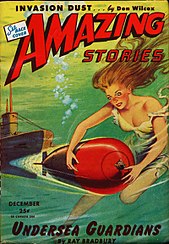
Bradbury's "Undersea Guardians" was the cover story for the December 1944 consequence of Amazing Stories
Bradbury'southward beginning published story was "Hollerbochen's Dilemma", which appeared in the January 1938 number of Forrest J. Ackerman's fanzine Imagination!.[1] In July 1939, Ackerman and his girlfriend Morojo gave 19-twelvemonth-old Bradbury the money to head to New York for the Starting time World Scientific discipline Fiction Convention in New York City, and funded Bradbury'southward fanzine, titled Futuria Fantasia.[24] Bradbury wrote most of its four bug, each limited to nether 100 copies.[ citation needed ] Between 1940 and 1947, he was a correspondent to Rob Wagner'due south picture show magazine, Script.[25]
Bradbury was free to start a career in writing when, attributable to his bad eyesight, he was rejected for induction into the military during World War 2. Having been inspired by scientific discipline-fiction heroes such as Wink Gordon and Buck Rogers, Bradbury began to publish science-fiction stories in fanzines in 1938. Bradbury was invited past Forrest J. Ackerman[ citation needed ] to nourish the Los Angeles Scientific discipline Fiction Society, which at the fourth dimension met at Clifton's Cafeteria in downtown Los Angeles. There he met the writers Robert A. Heinlein, Emil Petaja, Fredric Brown, Henry Kuttner, Leigh Brackett and Jack Williamson.[ citation needed ]
In 1939, Bradbury joined Laraine Solar day's Wilshire Players Society, where for two years, he wrote and acted in several plays. They were, every bit Bradbury afterwards described, "and then incredibly bad" that he gave up playwriting for two decades.[26] Bradbury'southward first paid piece, "Pendulum", written with Henry Hasse, was published in the lurid magazine Super Science Stories in November 1941, for which he earned $15.[27]
Bradbury sold his start solo story, "The Lake", for $13.75 at 22 and became a full-fourth dimension writer past 24.[22] His first collection of short stories, Dark Carnival, was published in 1947 by Arkham Business firm, a small printing in Sauk City, Wisconsin, owned by author Baronial Derleth. Reviewing Dark Carnival for the New York Herald Tribune, Will Cuppy proclaimed Bradbury "suitable for general consumption" and predicted that he would become a writer of the caliber of British fantasy writer John Collier.[28]
Later a rejection notice from the pulp Weird Tales, Bradbury submitted "Homecoming" to Mademoiselle, which was spotted past a immature editorial banana named Truman Capote. Capote picked the Bradbury manuscript from a slush pile, which led to its publication. Homecoming won a place in the O. Henry Honor Stories of 1947.[29]
In UCLA'southward Powell Library, in a written report room with typewriters for hire, Bradbury wrote his classic story of a volume burning future, The Fire-eater, which was about 25,000 words long. It was later published at about 50,000 words under the name Fahrenheit 451, for a total cost of $9.80, due to the library's typewriter-rental fees of ten cents per half-hour.[30]
A chance encounter in a Los Angeles bookstore with the British expatriate writer Christopher Isherwood gave Bradbury the opportunity to put The Martian Chronicles into the hands of a respected critic. Isherwood's glowing review followed.[31]
Writing [edit]
Bradbury attributed his lifelong habit of writing every solar day to 2 incidents. The first of these, occurring when he was three years onetime, was his female parent'due south taking him to run into Lon Chaney in the 1923 silent film The Hunchback of Notre Matriarch.[32] The 2d incident occurred in 1932, when a funfair entertainer, one Mr. Electrico, touched the young man on the nose with an electrified sword, made his hair stand on end, and shouted, "Alive forever!"[33] Bradbury remarked, "I felt that something strange and wonderful had happened to me because of my encounter with Mr. Electrico ... [he] gave me a future ... I began to write, full-time. I have written every unmarried solar day of my life since that day 69 years ago."[33] At that historic period, Bradbury first started to do magic, which was his start smashing beloved. If he had not discovered writing, he would have become a magician.[34]
Bradbury claimed a wide diversity of influences, and described discussions he might take with his favorite poets and writers Robert Frost, William Shakespeare, John Steinbeck, Aldous Huxley, and Thomas Wolfe. From Steinbeck, he said he learned "how to write objectively and however insert all of the insights without likewise much extra comment". He studied Eudora Welty for her "remarkable power to give you temper, character, and motion in a single line". Bradbury's favorite writers growing upwards included Katherine Anne Porter, Edith Wharton, and Jessamyn West.[35]
Bradbury was once described every bit a "Midwest surrealist" and is often labeled a science-fiction writer, which he described as "the art of the possible." Bradbury resisted that categorization, nonetheless:[36] [37]
First of all, I don't write science fiction. I've only done one scientific discipline fiction volume and that'southward Fahrenheit 451, based on reality. Scientific discipline fiction is a depiction of the real. Fantasy is a depiction of the unreal. So Martian Chronicles is not science fiction, information technology's fantasy. It couldn't happen, yous see? That'southward the reason it's going to be around a long time—because information technology'southward a Greek myth, and myths have staying power.[38]
Bradbury recounted when he came into his own equally a writer, the afternoon he wrote a short story nigh his commencement come across with death. When he was a boy, he met a young girl at a lake edge and she went out into the water and never came back. Years subsequently, as he wrote about it, tears flowed from him. He recognized he had taken the leap from emulating the many writers he admired to connecting with his vox as a author.[39]
When later asked about the lyrical ability of his prose, Bradbury replied, "From reading so much poesy every twenty-four hours of my life. My favorite writers have been those who've said things well." He is quoted, "If you're reluctant to weep, you won't live a full and complete life."[xl]
In high school, Bradbury was active in both the poetry society and the drama club, continuing plans to get an player, simply becoming serious about his writing equally his loftier school years progressed. Bradbury graduated from Los Angeles High School, where he took poetry classes with Snow Longley Housh, and short-story writing courses taught by Jeannet Johnson.[41] The teachers recognized his talent and furthered his interest in writing,[42] simply he did not nourish college. Instead, he sold newspapers at the corner of S Norton Avenue and Olympic Boulevard. In regard to his instruction, Bradbury said:
Libraries raised me. I don't believe in colleges and universities. I believe in libraries because well-nigh students don't have any coin. When I graduated from high school, information technology was during the Depression and we had no coin. I couldn't become to college, and so I went to the library three days a week for ten years.[43] [44]
He told The Paris Review, "Y'all can't learn to write in college. It's a very bad place for writers because the teachers ever recollect they know more than than you practise – and they don't."[45]
Bradbury described his inspiration as, "My stories run up and bite me in the leg—I respond by writing them down—everything that goes on during the bite. When I stop, the idea lets get and runs off".[46]
"Light-green Town" [edit]
A reinvention of Waukegan, Green Town is a symbol of condom and home, which is often juxtaposed every bit a contrasting backdrop to tales of fantasy or menace. It serves as the setting of his semiautobiographical classics Dandelion Vino, Something Wicked This Style Comes, and Good day Summer, also equally in many of his brusk stories. In Green Boondocks, Bradbury's favorite uncle sprouts wings, traveling carnivals conceal supernatural powers, and his grandparents provide room and board to Charles Dickens.[47] Perhaps the most definitive usage of the pseudonym for his hometown, in Summertime Morning, Summer Night, a collection of short stories and vignettes exclusively about Greenish Town, Bradbury returns to the signature locale as a look back at the apace disappearing small-boondocks world of the American heartland, which was the foundation of his roots.[48]
Cultural contributions [edit]
Bradbury wrote many brusk essays on the culture and the arts, attracting the attention of critics in this field, using his fiction to explore and criticize his civilization and society. Bradbury observed, for example, that Fahrenheit 451 touches on the alienation of people by media:
In writing the short novel Fahrenheit 451 I thought I was describing a world that might evolve in four or five decades. Simply only a few weeks ago, in Beverly Hills i nighttime, a married man and wife passed me, walking their canis familiaris. I stood staring after them, absolutely stunned. The woman held in ane hand a small cigarette-package-sized radio, its antenna quivering. From this sprang tiny copper wires which ended in a prissy cone plugged into her right ear. In that location she was, oblivious to human and dog, listening to far winds and whispers and soap opera cries, slumber walking, helped up and downwards curbs by a married man who might merely besides not have been there. This was not fiction.[49]
Bradbury stated that the novel worked as a critique of the later development of political correctness:
How does the story of Fahrenheit 451 stand upward in 1994?
R.B.: It works even better because we accept political correctness now. Political correctness is the real enemy these days. The blackness groups want to control our thinking and you tin can't say certain things. The homosexual groups don't want you lot to criticize them. Information technology's thought control and liberty of speech control.[50]
In a 1982 essay, he wrote, "People ask me to predict the Future, when all I want to exercise is prevent it". This intent had been expressed before by other authors,[51] who sometimes attributed it to him.
On May 24, 1956, Bradbury appeared on television in Hollywood on the popular quiz show You lot Bet Your Life hosted past Groucho Marx. During his introductory comments and on-air barrack with Marx, Bradbury briefly discussed some of his books and other works, including giving an overview of "The Veldt", his short story published six years earlier in The Saturday Evening Post nether the title "The World the Children Fabricated".[52]
Bradbury was a consultant for the American Pavilion at the 1964 New York Earth's Fair and wrote the narration script for The American Journeying attraction housed there.[53] [54] He also worked on the original showroom housed in Epcot's Spaceship Earth geosphere at Walt Disney World.[55] [56] [57] Bradbury concentrated on detective fiction in the 1980s.[58] In the latter half of the 1980s and early 1990s, he too hosted The Ray Bradbury Theater, a televised album series based on his short stories.
Bradbury was a strong supporter of public library systems, raising coin to prevent the closure of several libraries in California facing budgetary cuts. He said "libraries raised me", and shunned colleges and universities, comparing his own lack of funds during the Low with poor contemporary students.[59] His opinion varied on mod engineering science. In 1985 Bradbury wrote, "I see nothing simply good coming from computers. When they first appeared on the scene, people were saying, 'Oh my God, I'm so afraid.' I hate people like that – I phone call them the neo-Luddites", and "In a sense, [computers] are simply books. Books are all over the place, and computers will exist, as well".[60] He resisted the conversion of his piece of work into east-books, proverb in 2010, "We have too many cellphones. We've got too many internets. We have got to get rid of those machines. We have too many machines at present".[61] When the publishing rights for Fahrenheit 451 came upward for renewal in December 2011, Bradbury permitted its publication in electronic class provided that the publisher, Simon & Schuster, allowed the e-book to be digitally downloaded by any library patron. The title remains the just book in the Simon & Schuster itemize where this is possible.[62]
Several comic-book writers accept adapted Bradbury'southward stories. Particularly noted among these were EC Comics' line of horror and science-fiction comics. Initially, the writers plagiarized his stories, only a diplomatic letter from Bradbury about it led to the company paying him and negotiating properly licensed adaptations of his work. The comics featuring Bradbury'south stories included Tales from the Catacomb, Weird Science, Weird Fantasy, Law-breaking Suspenstories, and Haunt of Fear.[63]
Bradbury remained an enthusiastic playwright all his life, leaving a rich theatrical legacy, every bit well equally literary. Bradbury headed the Pandemonium Theatre Company in Los Angeles for many years and had a v-yr relationship with the Fremont Centre Theatre in Due south Pasadena.[64]
Bradbury is featured prominently in 2 documentaries related to his archetype 1950s–1960s era: Jason 5 Brock'south Charles Beaumont: The Life of Twilight Zone's Magic Man,[65] which details his troubles with Rod Serling, and his friendships with writers Charles Beaumont, George Clayton Johnson, and most especially his dear friend William F. Nolan, as well equally Brock's The AckerMonster Chronicles!, which delves into the life of old Bradbury agent, close friend, mega-fan, and Famous Monsters of Filmland editor Forrest J Ackerman.[ citation needed ]
Bradbury'south legacy was historic by the bookstore Fahrenheit 451 Books in Laguna Beach, California, in the 1970s and 1980s. Joseph Nicoletti did some Music-Moving picture Consulting for Ray Bradbury for a while, Nicoletti Lived in Laguna Beach and likewise did work for Wally Heider and Paramount Pictures' The Godfather III. The one thousand opening of an annex to the store was attended past Bradbury and his favorite illustrator, Joseph Mugnaini, in the mid-1980s. The shop closed its doors in 1987, but in 1990, another shop with the aforementioned name (with different owners) opened in Carlsbad, California.[66]
In the 1980s and 1990s, Bradbury served on the advisory board of the Los Angeles Educatee Film Institute.[67] [68]
Personal life [edit]

Bradbury in Dec 2009
Bradbury'due south wife was Marguerite McClure (January 16, 1922 – November 24, 2003) from 1947 until her expiry; they had iv daughters:[69] Susan, Ramona, Bettina and Alexandra.[lxx] Bradbury never obtained a driver'south license, but relied on public transportation or his bicycle.[71] He lived at dwelling until he was 27 and married. His married woman of 56 years, Maggie, every bit she was affectionately chosen, was the merely woman Bradbury ever dated.[22]
He was raised Baptist by his parents, who were themselves infrequent churchgoers. As an adult, Bradbury considered himself a "delicatessen religionist" who resisted categorization of his behavior and took guidance from both Eastern and Western faiths. He felt that his career was "a God-given matter, and I'yard so grateful, and so, and so grateful. The best description of my career as a writer is 'At play in the fields of the Lord.'"[72]
Bradbury was a shut friend of Charles Addams, and Addams illustrated the beginning of Bradbury's stories virtually the Elliotts, a family that resembled Addams' own Addams Family placed in rural Illinois. Bradbury's outset story about them was "Homecoming", published in the 1946 Halloween result of Mademoiselle, with Addams' illustrations. Addams and he planned a larger collaborative work that would tell the family's complete history, but information technology never materialized, and according to a 2001 interview, they went their separate ways.[73] In Oct 2001, Bradbury published all the Family unit stories he had written in one volume with a connecting narrative, From the Dust Returned, featuring a wraparound Addams cover of the original "Homecoming" illustration.[74]
Another shut friend was animator Ray Harryhausen, who was best man at Bradbury'southward wedding.[75] During a BAFTA 2010 awards tribute in honor of Ray Harryhausen's 90th birthday, Bradbury spoke of his beginning meeting Harryhausen at Forrest J Ackerman's business firm when they were both 18 years old. Their shared love for scientific discipline fiction, King Kong, and the Male monarch Vidor-directed film The Fountainhead, written by Ayn Rand, was the beginning of a lifelong friendship. These early influences inspired the pair to believe in themselves and affirm their career choices. Later their commencement meeting, they kept in impact at to the lowest degree in one case a month, in a friendship that spanned over 70 years.[76]
Late in life, Bradbury retained his dedication and passion despite what he described as the "devastation of illnesses and deaths of many good friends." Among the losses that deeply grieved Bradbury was the death of Star Trek creator Factor Roddenberry, who was an intimate friend for many years. They remained close friends for nearly three decades afterward Roddenberry asked him to write for Star Trek, which Bradbury never did, objecting that he "never had the ability to adapt other people'due south ideas into any sensible form."[22]
Bradbury suffered a stroke in 1999[77] that left him partially dependent on a wheelchair for mobility.[78] Despite this, he continued to write, and had even written an essay for The New Yorker, nigh his inspiration for writing, published only a week prior to his expiry.[79] Bradbury made regular appearances at science-fiction conventions until 2009, when he retired from the excursion.

Ray Bradbury's headstone in May 2012 prior to his decease
Bradbury chose a burial place at Westwood Hamlet Memorial Park Cemetery in Los Angeles, with a headstone that reads "Author of Fahrenheit 451".[eighty] [81] On February 6, 2015, The New York Times reported that the house that Bradbury lived and wrote in for l years of his life, at 10265 Cheviot Bulldoze in Cheviot Hills, Los Angeles, California, had been demolished by the buyer, builder Thom Mayne.[82]
Decease [edit]
Bradbury died in Los Angeles, California, on June 5, 2012, at the age of 91, after a lengthy illness.[83] Bradbury's personal library was willed to the Waukegan Public Library, where he had many of his formative reading experiences.[84]
The New York Times called Bradbury "the writer about responsible for bringing modern science fiction into the literary mainstream."[4] The Los Angeles Times credited Bradbury with the ability "to write lyrically and evocatively of lands an imagination away, worlds he anchored in the here and now with a sense of visual clarity and small-town familiarity".[85] Bradbury'south grandson, Danny Karapetian, said Bradbury'due south works had "influenced so many artists, writers, teachers, scientists, and information technology's always really touching and comforting to hear their stories".[lxx] The Washington Post noted several modern day technologies that Bradbury had envisioned much earlier in his writing, such as the idea of banking ATMs and earbuds and Bluetooth headsets from Fahrenheit 451, and the concepts of artificial intelligence within I Sing the Body Electric.[86]
On June 6, 2012, in an official public argument from the White House Printing Role, President Barack Obama said:
For many Americans, the news of Ray Bradbury'south decease immediately brought to mind images from his work, imprinted in our minds, often from a young age. His souvenir for storytelling reshaped our civilization and expanded our world. Simply Ray also understood that our imaginations could be used equally a tool for better understanding, a vehicle for change, and an expression of our nigh cherished values. In that location is no dubiety that Ray will proceed to inspire many more generations with his writing, and our thoughts and prayers are with his family unit and friends.[87]
Numerous Bradbury fans paid tribute to the writer, noting the influence of his works on their ain careers and creations.[88] [89] Filmmaker Steven Spielberg stated that Bradbury was "[his] muse for the improve function of [his] sci-fi career .... On the earth of science fiction and fantasy and imagination he is immortal".[ninety] Writer Neil Gaiman felt that "the mural of the world we live in would have been diminished if we had not had him in our world".[89] Author Stephen Rex released a statement on his website saying, "Ray Bradbury wrote iii cracking novels and three hundred great stories. 1 of the latter was called 'A Sound of Thunder'. The sound I hear today is the thunder of a giant's footsteps fading away. Merely the novels and stories remain, in all their resonance and strange dazzler."[91]
Bibliography [edit]
Bradbury authored "more than than 27 novels and story collections", which included many of his 600 short stories.[85] More than eight million copies of his works, published in over 36 languages, accept been sold around the globe.[4]

Bradbury's "The Gilded Apples of the Sun" was published in the November 1953 effect of Planet Stories.
First novel [edit]
In 1949, Bradbury and his wife were expecting their first child. He took a Greyhound autobus to New York and checked into a room at the YMCA for 50 cents a night. He took his brusque stories to a dozen publishers, simply no one wanted them. Only before getting prepare to go home, Bradbury had dinner with an editor at Doubleday. When Bradbury recounted that anybody wanted a novel and he did not have i, the editor, coincidentally named Walter Bradbury, asked if the short stories might be tied together into a book-length drove. The title was the editor'due south idea; he suggested, "Yous could call information technology The Martian Chronicles." Bradbury liked the idea and recalled making notes in 1944 to practise a book set on Mars. That evening, he stayed up all nighttime at the YMCA and typed out an outline. He took information technology to the Doubleday editor the next morning, who read information technology and wrote Bradbury a bank check for $750. When Bradbury returned to Los Angeles, he continued all the short stories that became The Martian Chronicles. [35]
Intended first novel [edit]
What was later issued every bit a collection of stories and vignettes, Summer Morn, Summer Night, started out to be Bradbury's offset true novel. The core of the work was Bradbury's witnessing of the American small-scale-town life in the American heartland.[ citation needed ]
In the winter of 1955–56, later on a consultation with his Doubleday editor, Bradbury deferred publication of a novel based on Green Town, the pseudonym for his hometown. Instead, he extracted 17 stories and, with three other Green Boondocks tales, bridged them into his 1957 book Dandelion Wine. Afterward, in 2006, Bradbury published the original novel remaining after the extraction, and retitled information technology Adieu Summertime. These two titles testify what stories and episodes Bradbury decided to retain as he created the ii books out of ane.[ citation needed ]
The near pregnant of the remaining unpublished stories, scenes, and fragments were published nether the originally intended name for the novel, Summer Morn, Summer Night, in 2007.[92]
Adaptations to other media [edit]

From 1950 to 1954, 31 of Bradbury's stories were adjusted by Al Feldstein for EC Comics (seven of them uncredited in six stories, including "Kaleidoscope" and "Rocket Man" being combined as "Dwelling house To Stay"—for which Bradbury was retroactively paid—and EC's first version of "The Handler" nether the title "A Strange Undertaking") and 16 of these were collected in the paperbacks, The Autumn People (1965) and Tomorrow Midnight (1966), both published past Ballantine Books with comprehend illustrations past Frank Frazetta. Also in the early 1950s, adaptations of Bradbury's stories were televised in several anthology shows, including Tales of Tomorrow, Lights Out, Out At that place, Suspense, CBS Television Workshop, Jane Wyman's Fireside Theatre, Star Tonight, Windows and Alfred Hitchcock Presents. "The Merry-Go-Round", a half-hour film adaptation of Bradbury'south "The Black Ferris", praised by Variety, was shown on Starlight Summertime Theater in 1954 and NBC's Sneak Preview in 1956. During that same menstruation, several stories were adapted for radio drama, notably on the science fiction anthologies Dimension X and its successor Ten Minus One.

Producer William Alland first brought Bradbury to movie theaters in 1953 with Information technology Came from Outer Space, a Harry Essex screenplay developed from Bradbury's screen handling "Atomic Monster". Three weeks subsequently came the release of Eugène Lourié'south The Beast from 20,000 Fathoms (1953), which featured ane scene based on Bradbury'southward "The Fog Horn", about a body of water monster mistaking the audio of a fog horn for the mating cry of a female. Bradbury's close friend Ray Harryhausen produced the stop-motion animation of the creature. Bradbury later on returned the favor past writing a short story, "Tyrannosaurus Rex", virtually a stop-motion animator who strongly resembled Harryhausen. Over the next 50 years, more than 35 features, shorts, and Tv movies were based on Bradbury's stories or screenplays. Bradbury was hired in 1953 by director John Huston to piece of work on the screenplay for his picture version of Melville's Moby Dick (1956), which stars Gregory Peck every bit Captain Ahab, Richard Basehart equally Ishmael, and Orson Welles as Male parent Mapple. A significant result of the film was Bradbury's volume Green Shadows, White Whale, a semifictionalized business relationship of the making of the film, including Bradbury's dealings with Huston and his fourth dimension in Ireland, where exterior scenes that were set in New Bedford, Massachusetts, were filmed.
Bradbury'southward short story I Sing the Torso Electric (from the book of the same name) was adapted for the 100th episode of The Twilight Zone. The episode was commencement aired on May 18, 1962.
Bradbury and managing director Charles Rome Smith co-founded the Pandemonium Theatre Company in 1964. Its starting time production was The World of Ray Bradbury, consisting of comedy adaptations of "The Pedestrian", "The Veldt", and "To the Chicago Completeness". It ran for four months at the Coronet Theatre in Los Angeles (October 1964 – February 1965); an off-Broadway production was presented in October 1965. Another Pandemonium Theatre Visitor product was mounted at the Coronet Theatre in 1965, again presenting adaptations of three Bradbury short stories: "The Wonderful Ice Cream Conform," "The Mean solar day It Rained Forever," and "Device Out of Time." (The last was adapted from his 1957 novel Dandelion Wine). The original cast for this production featured Booth Coleman, Joby Bakery, Fredric Villani, Arnold Lessing, Eddie Sallia, Keith Taylor, Richard Balderdash, Factor Otis Shane, Henry T. Delgado, F. Murray Abraham, Anne Loos, and Len Lesser. The director, again, was Charles Rome Smith.
Oskar Werner and Julie Christie starred in Fahrenheit 451 (1966), an accommodation of Bradbury's novel directed by François Truffaut.
In 1966, Bradbury helped Lynn Garrison create AVIAN, a specialist aviation magazine. For the get-go outcome, Bradbury wrote a poem, "Planes That Land on Grass".
In 1969, The Illustrated Human being was brought to the large screen, starring Rod Steiger, Claire Bloom, and Robert Drivas. Containing the prologue and three short stories from the volume, the motion-picture show received mediocre reviews. The same year, Bradbury approached composer Jerry Goldsmith, who had worked with Bradbury in dramatic radio of the 1950s and later scored the film version, to compose a cantata Christus Apollo based on Bradbury's text.[93] The piece of work premiered in tardily 1969, with the California Chamber Symphony performing with narrator Charlton Heston at UCLA.
In 1972, The Screaming Woman was adjusted equally an ABC Movie-of-the-Week starring Olivia de Havilland.
The Martian Chronicles became a three-part Television receiver miniseries starring Rock Hudson, which was kickoff broadcast by NBC in 1980. Bradbury found the miniseries "just boring".[96]
The 1982 television picture show The Electric Grandmother was based on Bradbury'due south short story "I Sing the Body Electric".
The 1983 horror film Something Wicked This Way Comes, starring Jason Robards and Jonathan Pryce, is based on the Bradbury novel of the aforementioned name.
In 1984, Michael McDonough of Brigham Young University produced "Bradbury thirteen", a series of xiii sound adaptations of famous stories from Bradbury, in conjunction with National Public Radio. The full-cast dramatizations featured adaptations of "The Ravine", "Night Call, Collect", "The Veldt", "There Was an Old Woman", "Kaleidoscope", "Nighttime They Were, and Gold-Eyed", "The Screaming Woman", "A Sound of Thunder", "The Man", "The Current of air", "The Fox and the Wood", "Here There Be Tygers", and "The Happiness Motorcar". Voiceover player Paul Frees provided narration, while Bradbury was responsible for the opening voiceover; Greg Hansen and Roger Hoffman scored the episodes. The series won a Peabody Award and two Gold Cindy awards and was released on CD on May ane, 2010. The serial began airing on BBC Radio 4 Extra on June 12, 2011.
From 1985 to 1992, Bradbury hosted a syndicated album television series, The Ray Bradbury Theater, for which he adapted 65 of his stories. Each episode began with a shot of Bradbury in his office, gazing over mementoes of his life, which he states (in narrative) are used to spark ideas for stories. During the commencement two seasons, Bradbury likewise provided additional voiceover narration specific to the featured story and appeared on screen.
Deeply respected in the USSR, Bradbury's fiction has been adapted into v episodes of the Soviet science-fiction Telly series This Fantastic Earth which adapted the stories film version of "I Sing The Body Electrical", Fahrenheit 451, "A Piece of Wood", "To the Chicago Abyss", and "Forever and the World".[97] In 1984 a cartoon adaptation of There Will Come Soft Rains («Будет ласковый дождь») came out by Uzbek managing director Nazim Tyuhladziev.[98] He made a film adaptation of The Veldt in 1987.[99] In 1989, a drawing accommodation of "Here There Be Tygers" («Здесь могут водиться тигры») past director Vladimir Samsonov came out.[100]
Bradbury wrote and narrated the 1993 animated television version of The Halloween Tree, based on his 1972 novel.
The 1998 motion picture The Wonderful Ice Cream Suit, released by Touchstone Pictures, was written by Bradbury. It was based on his story "The Magic White Arrange" originally published in The Saturday Evening Post in 1957. The story had also previously been adapted as a play, a musical, and a 1958 television version.
In 2002, Bradbury'due south own Pandemonium Theatre Visitor product of Fahrenheit 451 at Burbank's Falcon Theatre combined live acting with projected digital animation by the Pixel Pups.[101] In 1984, Telarium released a game for Commodore 64 based on Fahrenheit 451.[102]
In 2005, the film A Sound of Thunder was released, loosely based upon the curt story of the same name. The film The Butterfly Effect revolves around the same theory every bit A Sound of Thunder and contains many references to its inspiration. Short picture adaptations of A Slice of Wood and The Small Assassinator were released in 2005 and 2007, respectively.
In 2005, it was reported that Bradbury was upset with filmmaker Michael Moore for using the championship Fahrenheit 9/eleven, which is an innuendo to Bradbury's Fahrenheit 451, for his documentary well-nigh the George Due west. Bush administration. Bradbury expressed displeasure with Moore'due south apply of the title, but stated that his resentment was not politically motivated, though Bradbury was bourgeois-leaning politically.[103] Bradbury asserted that he did not want any of the coin made by the pic, nor did he believe that he deserved it. He pressured Moore to modify the proper name, but to no avail. Moore called Bradbury two weeks before the pic's release to repent, saying that the film'southward marketing had been set in motion a long fourth dimension agone and it was too late to change the title.[104]
In 2008, the film Ray Bradbury's Chrysalis was produced by Roger Lay Jr. for Urban Archipelago Films, based upon the short story of the same name. The movie won the best feature honour at the International Horror and Sci-Fi Film Festival in Phoenix. The film has international distribution by Arsenal Pictures and domestic distribution by Lightning Entertainment.
In 2010, The Martian Chronicles was adapted for radio by Colonial Radio Theatre on the Air.
Bradbury'southward works and arroyo to writing are documented in Terry Sanders' picture Ray Bradbury: Story of a Writer (1963).
Bradbury's poem "Groon" was voiced equally a tribute in 2012.[105]
Awards and honors [edit]

The Ray Bradbury Honor for excellency in screenwriting was occasionally presented by the Science Fiction and Fantasy Writers of America – presented to six people on four occasions from 1992 to 2009.[106] Beginning 2010, the Ray Bradbury Accolade for Outstanding Dramatic Presentation is presented annually co-ordinate to Nebula Awards rules and procedures, although it is not a Nebula Award.[107] The revamped Bradbury Award replaced the Nebula Laurels for Best Script.
- In 1971, an impact crater on the Moon was named Dandelion Crater by the Apollo xv astronauts, in accolade of Bradbury's novel Dandelion Wine.[108]
- In 1979, he was awarded an honorary Doctor of Letters (Litt.D.) degree from Whittier College.[109]
- In 1984, he received the Prometheus Award for Fahrenheit 451.
- In 1986, Ray Bradbury was a Guest of Honor at the 44th Globe Science Fiction Convention, which was held in Atlanta, Ga., from Baronial 28 to September one.[110]
- Ray Bradbury Park was dedicated in Waukegan, Illinois, in 1990. He was present for the ribbon-cut ceremony. The park contains locations described in Dandelion Wine, near notably the "113 steps". In 2009, a panel designed by artist Michael Pavelich was added to the park detailing the history of Ray Bradbury and Ray Bradbury Park.[111]
- An asteroid discovered in 1992 was named "9766 Bradbury"[112] in his honour.
- In 1994, he received the Peggy V. Helmerich Distinguished Author Award, presented annually by the Tulsa Library Trust.
- In 1994, he won an Emmy Award for the screenplay The Halloween Tree.
- In 2000, he was awarded the Medal for Distinguished Contribution to American Letters from the National Book Foundation.[113]
- For his contribution to the motion picture show manufacture, Bradbury was given a star on the Hollywood Walk of Fame on April 1, 2002.[114]
- In 2003, he received an honorary doctorate from Woodbury Academy, where he presented the Ray Bradbury Creativity Award each yr until his expiry.[115]
- On November 17, 2004, Bradbury received the National Medal of Arts, presented by President George W. Bush and Laura Bush.[116]
- Bradbury received a World Fantasy Accolade for Life Achievement at the 1977 World Fantasy Convention and was named Gandalf One thousand Chief of Fantasy at the 1980 World Science Fiction Convention.[117] In 1989 the Horror Writers Association gave him the quaternary or fifth Bram Stoker Award for Lifetime Achievement in horror fiction[118] and the Scientific discipline Fiction Writers of America made him its tenth SFWA M Main.[119] He won a Beginning Fandom Hall of Fame Award in 1996[120] and the Science Fiction and Fantasy Hall of Fame inducted him in 1999, its quaternary class of two deceased and two living writers.[121]
- In 2005, he was awarded the degree of Physician of Laws (honoris causa) by the National University of Republic of ireland, Galway, at a conferring ceremony in Los Angeles.
- On April 14, 2007, Bradbury received the Sir Arthur Clarke Honor's Special Laurels, given by Clarke to a recipient of his selection.
- On Apr xvi, 2007, Bradbury received a special citation by the Pulitzer Prize jury "for his distinguished, prolific, and deeply influential career as an unmatched writer of scientific discipline fiction and fantasy."[122]
- In 2007, Bradbury was made a Commandeur (Commander) of the Ordre des Arts et des Lettres (Guild of the Arts and Letters) by the French government.[123]
- In 2008, he was named SFPA Grandmaster.[124]
- On May 17, 2008, Bradbury received the inaugural J. Lloyd Eaton Lifetime Achievement Award in Science Fiction, presented by the UCR Libraries at the 2008 Eaton Scientific discipline Fiction Conference, "Chronicling Mars".[125]
- On November 19, 2008, Bradbury was presented with the Illinois Literary Heritage Award by the Illinois Middle for the Book.
- In 2009, Bradbury was awarded an Honorary Doctorate by Columbia College Chicago.[126]
- In 2010, Spike TV Scream Awards Comic-Con Icon Laurels went to Bradbury
- In 2012, the NASA Curiosity rover landing site ( 4°35′22″South 137°26′30″East / 4.5895°South 137.4417°E / -four.5895; 137.4417 )[127] [128] on the planet Mars was named "Bradbury Landing".[129] [130]
- On Dec 6, 2012, the Los Angeles street corner at 5th and Flower Streets was named "Ray Bradbury Square" in his laurels.[131]
- On February 24, 2013, Bradbury was honored at the 85th Academy Awards during that event'southward "In Memoriam" segment.[132]
Documentaries [edit]
Bradbury appeared in the documentary The Fantasy Film Worlds of George Pal (1985), produced and directed by Arnold Leibovit.[133]
References [edit]
- ^ a b Ray Bradbury at the Internet Speculative Fiction Database (ISFDB). Retrieved April 22, 2013.
- ^ "Inkpot Award". Comic-Con International: San Diego. December vi, 2012.
- ^ ""Mode" is replacing "genre" in critical terminology in order to broaden the range of critical discussion of specific types of literary expression. In the following link categorizing Victorian literature, "genre" is used for overall categories, such every bit poesy and nonfiction, and "mode" is used for particular kinds of literary types, such as realism and fantasy. Retrieved 28 February 2021".
- ^ a b c d Jonas, Gerald (June half dozen, 2012). "Ray Bradbury, Master of Science Fiction, Dies at 91". The New York Times . Retrieved June five, 2012.
- ^ Society for the Study of Midwestern Literature (2001). Greasley, Philip A. (ed.). Lexicon of Midwestern Literature. Vol. 1, The Authors. Indiana University Press. p. 77. ISBN9780253336095 . Retrieved March 5, 2014.
- ^ p.141 Bloom, Harold Ray Bradbury 2010 Infobase Publishing
- ^ Touponce, William F. "Ray (Douglas) Bradbury." American Writers: A Collection of Literary Biographies, Supplement iv. Ed. A Walton Litz and Molly Weigel. New York: Charles Scribner's Sons, 1996. Literature Resource from Gale. Nov xvi, 2010.
- ^ Document of Nascence, Ray Douglas Bradbury, August 22, 1920, Lake County Clerk's Record #4750. Although he was named afterward Rae Williams, a cousin on his father'due south side, Ray Bradbury'southward nativity document spells his first name as "Ray".
- ^ Paradowski, Robert J. "Ray Bradbury". Critical Survey of Short Fiction, Second Revised Edition" 2001:1–five. EBSCO. November 8, 2010.
- ^ Ray Bradbury's shut encounters with W.C. Fields, George Burns... past Susan King; Los Angeles Times, August 18, 2010
- ^ "Old Radio Shows.org". One-time Radio Shows.org.
- ^ Litz, A. Walton. American Writers Supplement Iv. New York: Charles Scribner's Sons, 1996. Print.
- ^ Weller, Sam (January 1, 2010). "Ray Bradbury, The Art of Fiction No. 203". Paris Review. No. 192. ISSN 0031-2037. Retrieved August 26, 2016.
- ^ Barnaby, Barnaby; Schulz, Monte, eds. (December 15, 2002). Snoopy's Guide to the Writing Life. Cincinnati, OH: Writer's Digest Books. pp. 161–164. ISBN1582971943.
- ^ Weller, Sam (January 1, 2010). "Ray Bradbury, The Art of Fiction No. 203". Paris Review. No. 192. ISSN 0031-2037. Retrieved Baronial 24, 2016.
- ^ Contemporary Authors Online. Ray Bradbury. Detroit: Gale, 2009. Web.
- ^ Heller, Terry. Magill'due south Survey of American Literature. Revised Edition. Pasadena: Salem Press, 2006. Impress.
- ^ McMillan, Gloria; Palumbo, Donald E.; Sullivan Iii, C. W. (September 17, 2013). Orbiting Ray Bradbury'due south Mars : biographical, anthropological, literary, scientific and other perspectives. McMillan, Gloria (Professor). Jefferson, North Carolina. ISBN9780786475766. OCLC 857141273.
- ^ The article linked appears in the source, simply this name conflicts with the group's spider web site.
- ^ "The Big Read". Neabigread.org. Retrieved July 6, 2012.
- ^ Ray Bradbury interview – The fine art of Fiction No. 203 The Paris Review; Bound, 2009
- ^ a b c d due east f Ken Kelley (1996). "Nigh Ray Bradbury Interview". Playboy.
- ^ "Ray Bradbury: "Russians have an unparalleled chapters for love"". www.rbth.ru. Russian federation Across The Headlines. June 7, 2012. Retrieved September 15, 2012.
- ^ Marguerite bradbury – Ray Bradbury Discussion Ray Bradbury Official website
- ^ Sam Weller (Jump 2010). "Ray Bradbury, The Art of Fiction No. 203". The Paris Review. Spring 2010 (192).
- ^ Bradbury, Ray (1972). The Veldt. Woodstock, Illinois: Dramatic Publishing. p. 4. ISBN978-1-58342-028-7.
- ^ "Biographies: Bradbury, Raymond Douglas". s9.com. Retrieved Dec 9, 2009.
- ^ Cuppy, Will, "Review of Dark Funfair," New York Herald Tribune Books, May 25, 1947.
- ^ Ray Bradbury, From Truman Capote to A.T.Thousand.'s, by Dean Robinson – 6th flooring; The New York Times, June 6, 2012
- ^ A Bruin Birthday Tribute To Ray Bradbury Tweet (August 22, 2010). "Outset Spark: Ray Bradbury Turns 90; The Universe and UCLA University Celebrate". Spotlight.ucla.edu. Archived from the original on October v, 2011. Retrieved September 30, 2011.
- ^ Isherwood, Christopher (October 1950), "A Review of The Martian Chronicles", Tomorrow, 10: 56–58
- ^ Paradowski, Robert J. "Ray Bradbury." Critical Survey of Short Fiction, 2d Revised Edition (2001): UFO. Nov ten, 2010.
- ^ a b "In His Words". RayBradbury.com. Retrieved Dec 9, 2009.
- ^ Terry Sanders' film Ray Bradbury: Story of a Writer (1963)
- ^ a b The Art of Fiction No. 203: Ray Bradbury, Interviewed by Sam Weller; The Paris Review, Jump 2010
- ^ A Conversation with Ray Bradbury Betoken Loma Nazarene University, Writer'southward Symposium By The Body of water; "The only science fiction I have written is Fahrenheit 451. It'due south the art of the possible. Scientific discipline fiction is the art of the possible. Information technology could happen. It has happened." Word of genres, finding i'due south vox. April 2001; Cosmos Learning, English language Literature
- ^ Ray Bradbury interview Archived February five, 2013, at the Wayback Auto "I am not a science fiction writer. I am a fantasy writer. Just the characterization got put on me and stuck." March 23, 2005
- ^ Wil Gerken; Nathan Hendler; Doug Floyd; John Banks. "Books: Grandfather Time (Weekly Excuse . 09-27-99)". Weeklywire.com. Retrieved February 14, 2010.
- ^ Bradbury, Ray (1990). Zen in the Art of Writing.
- ^ Personal lessons from futurist Ray Bradbury on crying, escaping, laughing, by Mick Mortlock; Oregon Live, June vi, 2012
- ^ Ray Bradbury Biography Ray Bradbury Online
- ^ Litz, A. Walton, and Molly Weigel, eds. American Writers (Supp. four, Pt. ane). New York: Macmillan Library Reference. 1996. Print.
- ^ Steinhauer, Jennifer (June nineteen, 2009). "A Literary Legend Fights for a Local Library". The New York Times . Retrieved Dec 9, 2009.
- ^ "Mayor, Writer Launch Library Funding Drive". Los Angeles Times, October i, 1988
- ^ Weller, Interviewed by Sam (2010). "Ray Bradbury Interview". Vol. Spring 2010, no. 192. The Paris Review
- ^ Garg, Anu, A Word a 24-hour interval, 2017.08.22, wordsmith.org
- ^ "Summer Morning, Summer Dark by Ray Bradbury". Subterranean Press. Archived from the original on Baronial 22, 2015.
- ^ Sites from these works which all the same exist in Waukegan include his boyhood dwelling, his grandparents' habitation next door (and their connecting lawns where his grandfather and he gathered dandelions to make wine) and, less than a block away, the famous ravine which Bradbury used equally a metaphor throughout his career.
- ^ Quoted by Kingsley Amis in New Maps of Hell: A Survey of Science Fiction (1960).
- ^ Gasior, Ann (Oct 1, 1994). "Bradbury Talk Likely to Characteristic the Unexpected". Florida State University Libraries. Dayton Daily News. pp. 104–105. Retrieved June ii, 2018.
- ^ "I Do Not Want to Predict the Future. I Desire to Prevent It". Quote Investigator. Retrieved February 21, 2015.
- ^ You Bet Your Life #55-35 Science fiction writer Ray Bradbury (Hugger-mugger word 'Firm', May 24, 1956). YouTube. Nov sixteen, 2013. Archived from the original on October 29, 2021.
- ^ "Screen: Riding Through U.Due south. History; ' The American Journeying' Roofing 400 Years at Federal Pavilion". timesmachine.nytimes.com . Retrieved July 15, 2020.
- ^ Bradbury, Ray. "The American Journey".
- ^ Ray Bradbury. "In 1982 he created the interior metaphors for the Spaceship Earth brandish at Epcot Center, Disney World".
- ^ Ray Bradbury. "The images at Spaceship Earth in Disney World'south EPCOT Center in Orlando? Well, they are all Bradbury's ideas".
- ^ Ray Bradbury. "He also serves as a consultant, having collaborated, for example, in the design of a pavilion in the Epcot Center at Walt Disney Globe." Referring to Spaceship Earth ... raybradbury.com
- ^ Litz, A. Walton., and Molly V. Weigel. American Writers: a Collection of Literary Biographies. New York: Scribner, 1996. Print
- ^ Steinhauer, Jennifer (June xix, 2009). "A Literary Legend Fights for a Local Library". The New York Times . Retrieved June vii, 2012.
- ^ Lemley, Brad (January 8, 1985). "Other Voices, Other Futures". PC Mag. p. 133. Retrieved October 28, 2013.
- ^ "Fahrenheit 451 becomes e-book despite author'due south feelings". BBC News. November thirty, 2011. Retrieved Dec 1, 2011.
- ^ Jablon, Robert (June 6, 2012). "'Fahrenheit 451' Author Ray Bradbury Dies at 91". Time. Archived from the original on June 8, 2012. Retrieved June 6, 2012.
- ^ "Ray Bradbury: Comic Book Hero". The Saturday Evening Post. August 22, 2019. Retrieved June 17, 2021.
- ^ Ray Bradbury, 91, leaves a rich theatrical legacy too by David Ng; Los Angeles Times, June 6, 2012
- ^ French, Lawrence "Richard Matheson remembers his good friend Charles Beaumont", March 24, 2010. Retrieved October 31, 2012.
- ^ Ray Riegert, Hidden Coast of California: The Adventurer's Guide (Berkeley, Cal.: Ulysses Printing, 1988), p. 133.
- ^ National Student Film Institute/L.A: The Sixteenth Annual Los Angeles Educatee Film Festival. The Directors Guild Theatre. June 10, 1994. pp. x–11.
- ^ Los Angeles Student Film Establish: 13th Annual Student Film Festival. The Directors Guild Theatre. June 7, 1991. p. 3.
- ^ "Telegraph obituary". The Daily Telegraph. June 6, 2012. Archived from the original on January xi, 2022. Retrieved June 6, 2012.
- ^ a b "Author Ray Bradbury dies, aged 91". BBC News. June vi, 2012. Retrieved June half-dozen, 2012.
- ^ Riddle, Warren (June 25, 2009). "Sci-Fi Writer Ray Bradbury Trashes the Web". Switched. Archived from the original on Oct 1, 2011. Retrieved Dec 9, 2009.
- ^ Blake, John (August two, 2010). "Sci-fi legend Ray Bradbury on God, 'monsters and angels'". CNN. Retrieved October 14, 2015.
- ^ Interview with Ray Bradbury Archived February 3, 2009, at the Wayback Motorcar in IndieBound, autumn 2001.
- ^ Bradbury, Ray, From The Grit Returned: A Novel. William Morrow, 2001.
- ^ Whitaker, Sheila (May 7, 2013). "Ray Harryhausen obituary". The Guardian . Retrieved June 4, 2013.
- ^ BAFTA Online. "Ray Bradbury pays Tribute to Ray Harryhausen". YouTube. Archived from the original on October 29, 2021. Retrieved July 12, 2010.
- ^ Ryan, Joal (November 12, 1999). "Sci-Fi Smashing Ray Bradbury Suffers Stroke". E!. Retrieved June 6, 2012.
- ^ Rogers, Jim (Jan 18, 2002). "Ray Bradbury Still Writing At 81". CBS News. Associated Press. Retrieved June 6, 2012.
- ^ Bradbury, Ray (June 4, 2012). "Take Me Dwelling". The New Yorker . Retrieved June vi, 2012.
- ^ "Visiting Marilyn Monroe's grave: Resting places of the rich and famous". Test Design. MSNBC. Baronial 15, 2007. Archived from the original on February 14, 2012. Retrieved April 7, 2012.
- ^ Guthrie, Bruce. "CA – Westwood – Pierce Bros. Westwood Hamlet Memorial Park: Ray Bradbury". Bruce Guthrie Photos . Retrieved April 7, 2012.
- ^ Nagourney, Adam (Feb 6, 2015). "Classic or Ramshackle, One-time Homes in Los Angeles Are Being Bulldozed Into History". The New York Times . Retrieved February 6, 2015.
- ^ Duke, Alan (June 6, 2012). "Sci-fi legend Ray Bradbury dies". CNN. Retrieved June six, 2012.
- ^ Russell Lissau (June 17, 2013). "Ray Bradbury book collection going to Waukegan library". Daily Herald.
- ^ a b George, Lynell (June vi, 2012). "Ray Bradbury dies at 91; author lifted fantasy to literary heights". Los Angeles Times . Retrieved June 6, 2012.
- ^ Tsukayama, Hayley (June half-dozen, 2012). "Dreams of Ray Bradbury: ten predictions that came truthful". The Washington Mail . Retrieved June 6, 2012.
- ^ "Statement by the President on the Passing of Ray Bradbury". whitehouse.gov. June half-dozen, 2012. Retrieved June 8, 2012 – via National Archives.
- ^ "Tributes paid to sci-fi writer Ray Bradbury". BBC News. June 6, 2012. Retrieved June vi, 2012.
- ^ a b "Writers, filmmakers react to Ray Bradbury's death". Boston World. Associated Press. June half-dozen, 2012. Retrieved June 6, 2012.
- ^ Zeitchik, Steven (June 6, 2012). "Ray Bradbury was a huge influence on the film world too". Los Angeles Times . Retrieved June 6, 2012.
- ^ Stephen Comments on the Expiry of Ray Bradbury. Stephen King. Retrieved June vii, 2012.
- ^ Summer Morning, Summer Nighttime, by Ray Bradbury; PS Publishing, 2007
- ^ Goldsmith, Jerry (2002). Jerry Goldsmith: Christus Apollo (CD). Telarc.
- ^ Jessie Lendennie, ed. (2006). "If Just We Had Taller Been". Daughter and Other Poems. Salmon Publishing. pp. 57–58. ISBN9781903392102.
- ^ In Memoriam: Ray Bradbury 1920–2012. Jet Propulsion Laboratory. June 6, 2012. Retrieved June vii, 2012.
- ^ Weller, Sam (2005). The Bradbury Chronicles: The Life of Ray Bradbury. New York: HarperCollins. pp. 301–302. ISBN978-0-06-054581-nine.
- ^ "State fund of Television and Radio Programs" (in Russian).
- ^ Будет ласковый дождь (in Russian). Archived from the original on September 9, 2012.
- ^ "Вельд", Киностудия "Узбекфильм", 1987 (in Russian).
- ^ Мультипликационные фильмы. Творческое объединение «Экран» (in Russian). Archived from the original on February 1, 2016. Retrieved August 14, 2015.
- ^ "fahrenheit 451 and ray bradbury and flames and fire and falcon theatre and pixel pups and fahrenheit 451". Baronial 27, 2005. Archived from the original on August 27, 2005.
- ^ "Lemon64.com - all about Commodore 64". Lemon64.
- ^ Fund, John (June 6, 2012). "Ray Bradbury, a Great Conservative". Nationalreview.com. Retrieved June vi, 2012.
- ^ Weller, Sam (2005). The Bradbury Chronicles: The Life of Ray Bradbury. New York: HarperCollins. pp. 330–331. ISBN978-0-06-054581-9.
- ^ "Groon" (a poem) by Ray Bradbury. Vimeo.
- ^ "Other SFWA Awards" Archived October 16, 2011, at the Wayback Machine. The Locus Alphabetize to SF Awards: About the Awards. Locus Publications. Retrieved April 2, 2013.
- ^ "Frequently Asked Questions" Archived July five, 2011, at the Wayback Auto. SFWA. Retrieved Apr ii, 2013. Quote: "Constructive January 2009, hither are the new rules for the Nebula Awards."
- ^ "Ray Bradbury: Jovial, much-lauded writer of Fahrenheit 451 whose economic prose and insatiable curiosity won many converts to science fiction". The Times. June 7, 2012.
- ^ "Honorary Degrees | Whittier Higher". www.whittier.edu . Retrieved January 28, 2020.
- ^ 44th Earth Science Fiction Convention program of events, 1986.
- ^ Keilman, John (June 7, 2012). "Waukegan'due south mural, values never left Bradbury". Chicago Tribune . Retrieved July 15, 2012.
- ^ "Small-Body Database Lookup". ssd.jpl.nasa.gov.
- ^ Distinguished Contribution to American Letters Laurels with his credence spoken communication.
- ^ "Ray Bradbury Receives Star on Hollywood Walk of Fame". Printing release, office of Mayor Hahn, April ane, 2002. Retrieved April 2, 2013.
- ^ "Woodbury mourns the passing of Ray Bradbury". Woodbury university. June half-dozen, 2012. Archived from the original on June 18, 2012. Retrieved July 15, 2012.
- ^ "Lifetime honors: National medal of the arts". National Endowment for the arts. Archived from the original on March 2, 2010. Retrieved July xv, 2012.
- ^ "Bradbury, Ray" Archived October 16, 2012, at the Wayback Machine. The Locus Index to SF Awards: Index to Literary Nominees. Locus Publications. Retrieved March 22, 2013.
- ^ "Bram Stoker Award for Lifetime Achievement" Archived May 9, 2013, at the Wayback Machine. Horror Writers Association (HWA). Retrieved April six, 2013.
- ^ "Damon Knight Memorial Thou Main" Archived July ane, 2011, at the Wayback Machine. Science Fiction and Fantasy Writers of America (SFWA). Retrieved April 2, 2013.
- ^ "First Fandom: First Fandom hall of fame award". Starting time Fandom. Archived from the original on July 23, 2012. Retrieved July 15, 2012.
- ^ "Science Fiction and Fantasy Hall of Fame" Archived May 21, 2013, at the Wayback Car. Mid American Science Fiction and Fantasy Conventions, Inc. Retrieved March 22, 2013. This was the official website of the hall of fame to 2004.
- ^ "The 2007 Pulitzer Prize Winners: Special Awards and Citations". The Pulitzer Prizes. Retrieved November two, 2013.
- ^ "The U.s. conference of mayors, 80th annual meeting: Honoring the life of Ray Bradbury". The Usa conference of mayors. June xiii–16, 2012. Archived from the original on February 2, 2013. Retrieved July 15, 2012.
- ^ Wilson, Stephen 1000. (2008). "2008 SFPA Grandmaster". The Science Fiction Poesy Association. SFPA. Retrieved August 3, 2008.
- ^ "The Eaton Awards". Eaton Science Fiction Conference. University of California, Riverside (ucr.edu). Retrieved April two, 2013.
- ^ "College history: Honorary caste recipients". Columbia University. 2011. Archived from the original on October 23, 2010. Retrieved July 15, 2012.
- ^ MSNBC Staff (Baronial six, 2012). "Video from rover looks downwards on Mars during landing". NBC News. Retrieved October seven, 2012.
- ^ Young, Monica (August 7, 2012). "Lookout man Curiosity Descend onto Mars". SkyandTelescope.com. Archived from the original on December 9, 2012. Retrieved Oct 7, 2012.
- ^ Dark-brown, Dwayne; Cole, Steve; Webster, Guy; Agle, D.C. (August 22, 2012). "NASA Mars Rover Begins Driving at Bradbury Landing". NASA. Retrieved August 22, 2012.
- ^ Curiosity Rover [@MarsCuriosity] (Baronial 22, 2012). "In tribute, I dedicate my landing spot on Mars to you lot, Ray Bradbury. Greetings from Bradbury Landing! [motion picture]twitpic.com/amjkm6" (Tweet). Retrieved January two, 2019 – via Twitter.
- ^ Bob Puddle, Intersection most L.A. library named for Ray Bradbury, Los Angeles Times, December 6, 2012
- ^ "Oscars 'In Memoriam' 2013: Total list". MSN. Archived from the original on January 18, 2014. Retrieved Feb 25, 2013.
- ^ "The Fantasy Motion-picture show Worlds of George Pal". IMDb. IMDb.com, Inc. December 1, 2019. Retrieved December 1, 2019.
Sources [edit]
- Anderson, James Arthur (2013). The Illustrated Ray Bradbury. Wildside Press. ISBN978-i-4794-0007-2.
- Albright, Donn (1990). Bradbury Bits & Pieces: The Ray Bradbury Bibliography, 1974–88. Starmont House. ISBN978-one-55742-151-7.
- Eller, Jonathan R.; Touponce, William F. (2004). Ray Bradbury: The Life of Fiction. Kent State University Press. ISBN978-0-87338-779-eight.
- Eller, Jonathan R. (2011). Becoming Ray Bradbury. Urbana, IL: University of Illinois Press. ISBN978-0-252-03629-3.
- Nolan, William F. (1975). The Ray Bradbury Companion: A Life and Career History, Photolog, and Comprehensive Checklist of Writings. Gale Research. ISBN978-0-8103-0930-two.
- Paradowski, Robert J.; Rhynes, Martha E. (2001). Ray Bradbury. Salem Printing.
- Reid, Robin Anne (2000). Ray Bradbury: A Disquisitional Companion. Greenwood Press. ISBN978-0-313-30901-4.
- Constrict, Donald H. (1974). The Encyclopedia of Science Fiction and Fantasy. Chicago: Advent. pp. 61–63. ISBN978-0-911682-20-v.
- Weist, Jerry (2002). Bradbury, an Illustrated Life: A Journeying to Far Metaphor. William Morrow and Visitor. ISBN978-0-06-001182-6.
- Weller, Sam (2005). The Bradbury Chronicles: The Life of Ray Bradbury. HarperCollins. ISBN978-0-06-054581-9.
External links [edit]
Source: https://en.wikipedia.org/wiki/Ray_Bradbury
0 Response to "Ray William Johnson So Called Art Man With Pole"
Post a Comment