Portrait of Man Holding Letter Florentine 16th Century Art of Gesu
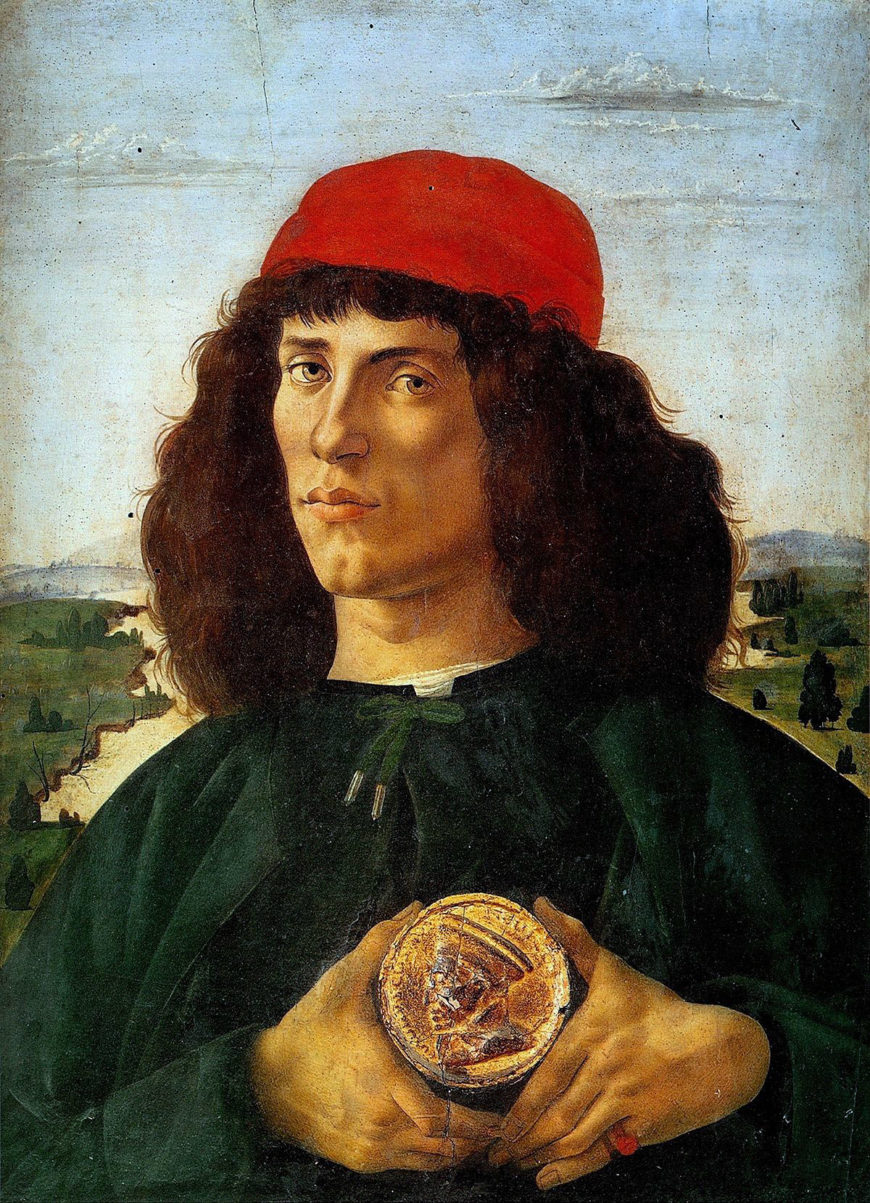
Sandro Botticelli, Portrait of a Human with a Medal of Cosimo il Vecchio de' Medici, c. 1474, tempera on console, 57.v x 44 cm (Gallerie degli Uffizi, Florence)
When browsing a museum, I'g certain we've all experienced the potent want to touch a work of art (we know we shouldn't, only I retrieve we can acknowledge we've all wanted to). Well, Sandro Botticelli's Portrait of a Homo with a Medal of Cosimo il Vecchio de' Medici was made to incite bear upon, or at to the lowest degree to make viewers call up about touch and physical experience.
Seeing Botticelli's Portrait of a Homo reproduced online, in the pages of a book, or even when walking by it in Florence's Galleria degli Uffizi, where it is protected by a layer of glass, modernistic viewers may miss a key aspect of the painting. However, the typical fifteenth-century viewer of this portrait likely would have been able to touch the object itself, and at the very least could hands draw from memory the experience of handling an object much like the medallion held by the portrait sitter, as portrait medallions were frequently dispersed and collected among the upper classes.
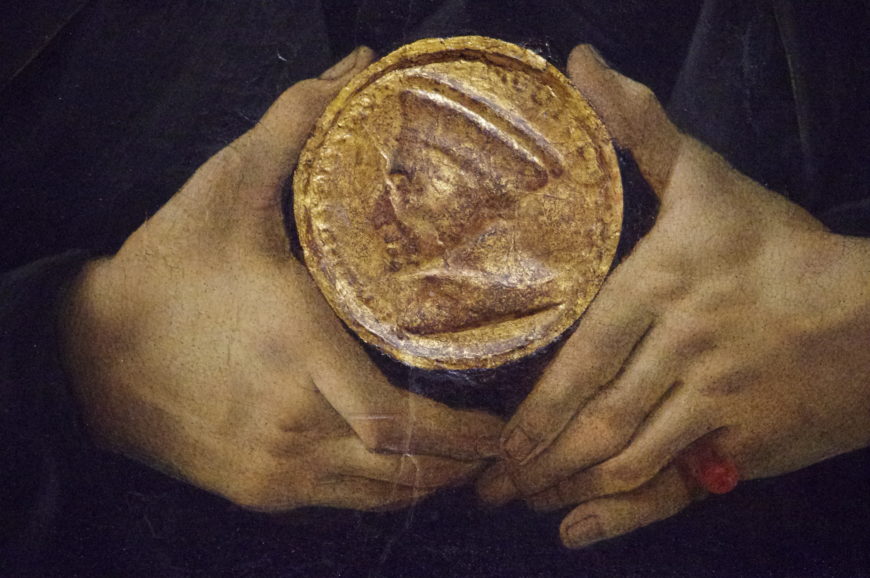
Sandro Botticelli, item of Portrait of a Man with a Medal of Cosimo il Vecchio de' Medici, c. 1474, tempera on panel, 57.5 10 44 cm (Gallerie degli Uffizi, Florence; photograph: dvdbramhall, CC BY-NC-ND 2.0)
Upon closer inspection, you lot'll discover that this isn't a ii-dimensional portrait painting, but a multimedia work. The sitter is indeed painted quite naturalistically, so he looks 3-dimensional, every bit though he could potentially exist in our world. The medallion that he holds, however, really is three-dimensional . This portrait, similar many paintings in fifteenth-century Italy, is painted with tempera on a woods panel. In this instance, a pigsty has been cut in the panel, where the sitter appears to exist holding the medallion, and a copy of a real portrait medallion has been inserted into that space.
This pseudo-medallion is non actually made of metal, as a true medallion is, simply information technology is instead built of pastiglia , a paste or plaster, made with gesso and built in low relief. In this portrait, the pastiglia medallion has also been gilt, or covered in a sparse layer of gold leaf, to mimic the advent of a golden bronze medallion. Because the image and text on this pseudo-medallion exactly mimic the orientation of Cosimo'southward portrait on real medallions from this period, it is possible that Botticelli used the impression of an existing medallion to make a mold, or had access to a mold used to create such medallions.
Who is this man?
Well, we don't know, despite much scholarly speculation over the years. We tin discern that he is certainly intending to acquaintance himself with i of the most powerful families in Italy at this time, the Medici. He does so by holding a large copy of a existent, existing portrait medallion—an object that would accept been made in multiples, circulated, traded, and nerveless by humanists and upper-class members of Renaissance society.
The young human in Botticelli's portrait looks directly out at the viewer and appears proud of his connectedness to the object that he holds. He displays the large medallion right over his center, an organ that was associated with the creation of lasting memories and the storage of sense impressions. The sitter is dressed as a humanist, a learned member of Florentine society.
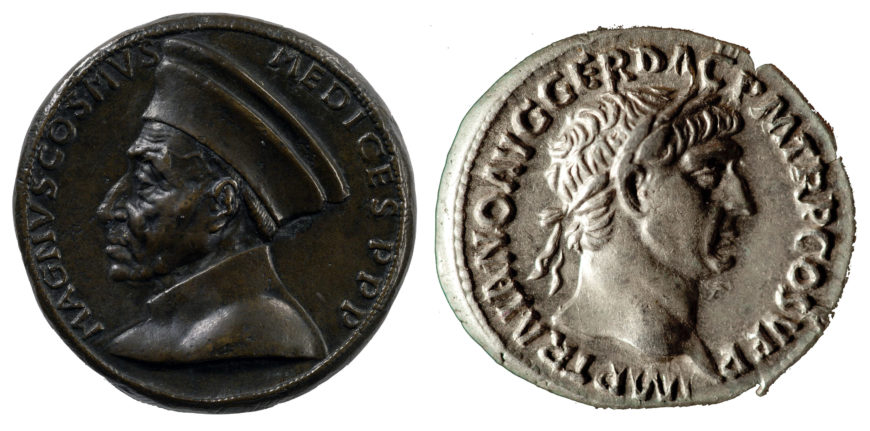
Left: Cosimo de' Medici, c. 1480–1500, statuary medal, fabricated in Florence (© Victoria and Albert Museum, London); right: Trajan Denarius, Roman Dacia, 107 C.E. (Roman Numismatics Collection; photo: courtesy of James Grout/Encyclopedia Romana)
The medallion, equally a copy of a existent object, shows the profile view of Cosimo il Vecchio (the Elder), with Latin text arching above his portrait. The text makes reference to Cosimo il Vecchio as pater patriae , or "Father of the Fatherland." This phrase indicated the political ability of the Medici, which began during Cosimo'southward lifetime. The format of the pseudo-medallion is fatigued from coins and medals of Greek and Roman antiquity, thereby effectively associating Cosimo with great rulers of a learned past, a by that Renaissance humanists hoped to emulate.
Who were the Medici?
Why would someone in Renaissance Italia want to be associated with the Medici family? And why Cosimo il Vecchio, in particular? The Medici were the most powerful family unit in Florence, and remained one of the nigh influential families in Italy—and Western Europe more broadly—throughout the Renaissance. Even though Cosimo il Vecchio was deceased by the time of this portrait, he was remembered equally the de-facto "father" of the wealthy cyberbanking, mercantile, and political family unit. Beginning with Cosimo and his political dominion, the Medici helped to make Florence the cradle and birthplace of the Italian Renaissance , equally they were responsible for financially supporting many advances in the arts and humanities. By 1475, when this portrait was painted, the grandsons of Cosimo, Lorenzo and Giuliano, were co-rulers of Florence. Just a few years later, in 1478, Giuliano was killed in the Florentine Cathedral of Santa Maria del Fiore (the Duomo ) during the assassination plot known as the Pazzi Conspiracy. At this time, Lorenzo il Magnifico (the Magnificent) de' Medici became head of the family unit and the Medici rule in Florence.
Lorenzo, in particular, surrounded himself and filled his court with artists, architects, writers, and other humanist scholars. Sandro Botticelli was 1 of these, looked upon quite favorably by Lorenzo and given numerous commissions during his time every bit a court painter for the Medici. This portrait was thus created during one of the corking heights of Medici Renaissance power and influence. In only a few decades, in fact, two members of the family would become popes—Pope Leo 10 (Giovanni di Lorenzo de' Medici) and Pope Cloudless 7 (Giulio di Giuliano de' Medici). In short, if i had the ability to claim even a tangential connection to the Medici family unit, information technology would only brand sense to document that connectedness for eternity in a work of art, such every bit our Man with a Medal .

Sandro Botticelli, Adoration of the Magi, c. 1475–76, tempera on panel, 111 10 134 cm (Gallerie degli Uffizi, Florence). A cocky-portrait of Botticelli appears on the far-right side; he is the man looking out at viewers and dressed in golden robes.
Botticelli, the Medici, and Renaissance portraiture
And, over again, Botticelli was able to claim just such a connection himself. In fact, the creative person famously includes his self-portrait in an image of the Adoration of the Magi , also painted around 1475. The Medici were known to frequently acquaintance themselves with the three kings as a way of showing their loyalty to the Christian faith and their will to besides gift expensive things to Christ (carried out in the Renaissance past style of commissioning religious works of art and architecture). As such, many recognizable portraits of Medici family members can exist found in the Adoration of the Magi . Botticelli perpetually commemorates his connectedness to this powerful family unit past calculation his own portrait to the grouping.
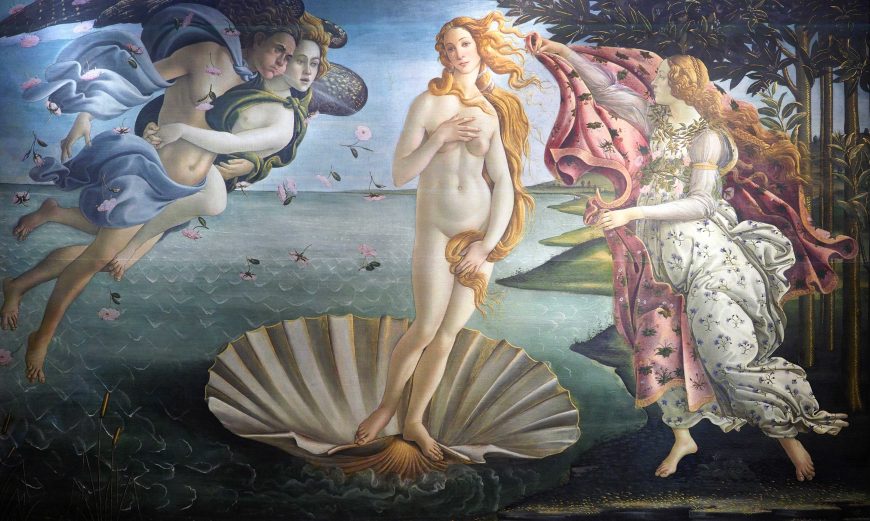
Sandro Botticelli, The Nativity of Venus, 1483-85, tempera on panel, 68 ten 109 5/8″ (172.5 x 278.v cm) (Gallerie degli Uffizi, Florence; photo: Steven Zucker, CC By-NC-SA ii.0)
The best-known works by Botticelli are religious and mythological scenes, such equally his Nativity of Venus , which can besides be found in the Uffizi Gallery. However, Botticelli was also widely celebrated for his technical abilities in the genre of portraiture. In the terminal quarter of the fifteenth century, artists were continually working towards creating ever more than communicative and naturalistic portraits.
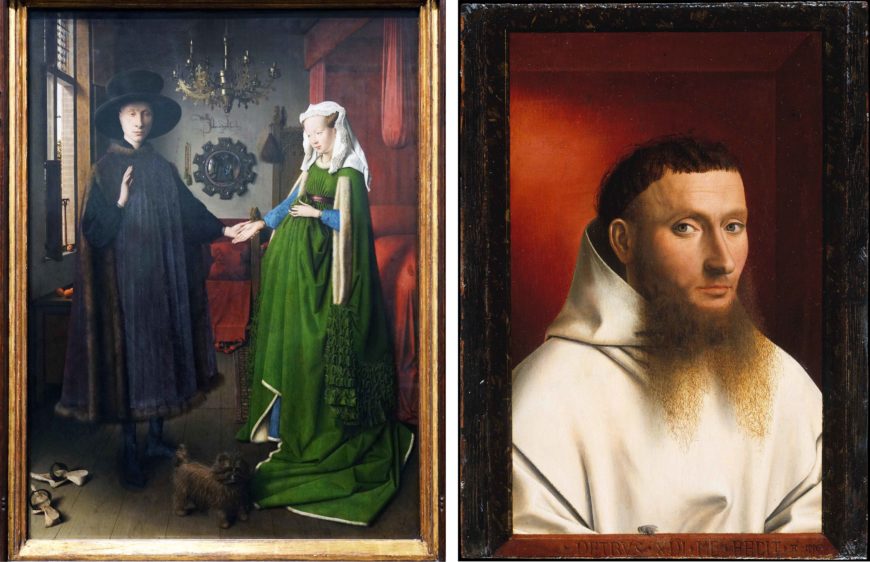
Two examples of northern renaissance portraits. Left: Jan Van Eyck, The Arnolfini Portrait, 1434, tempera and oil on oak panel, 82.ii ten 60 cm (National Gallery, London; photo: Steven Zucker, CC BY-NC-SA 2.0); right: Petrus Christus, Portrait of a Carthusian, 1446 (Metropolitan Museum of Art, New York; photo: Steven Zucker, CC Past-NC-SA 2.0)
Moving away from the classically-inspired strict profile format and turning to a three-quarter twist of the body inspired by Flemish portraiture, artists like Botticelli, Leonardo da Vinci , and Antonello da Messina were revolutionizing the entire genre of portraiture.
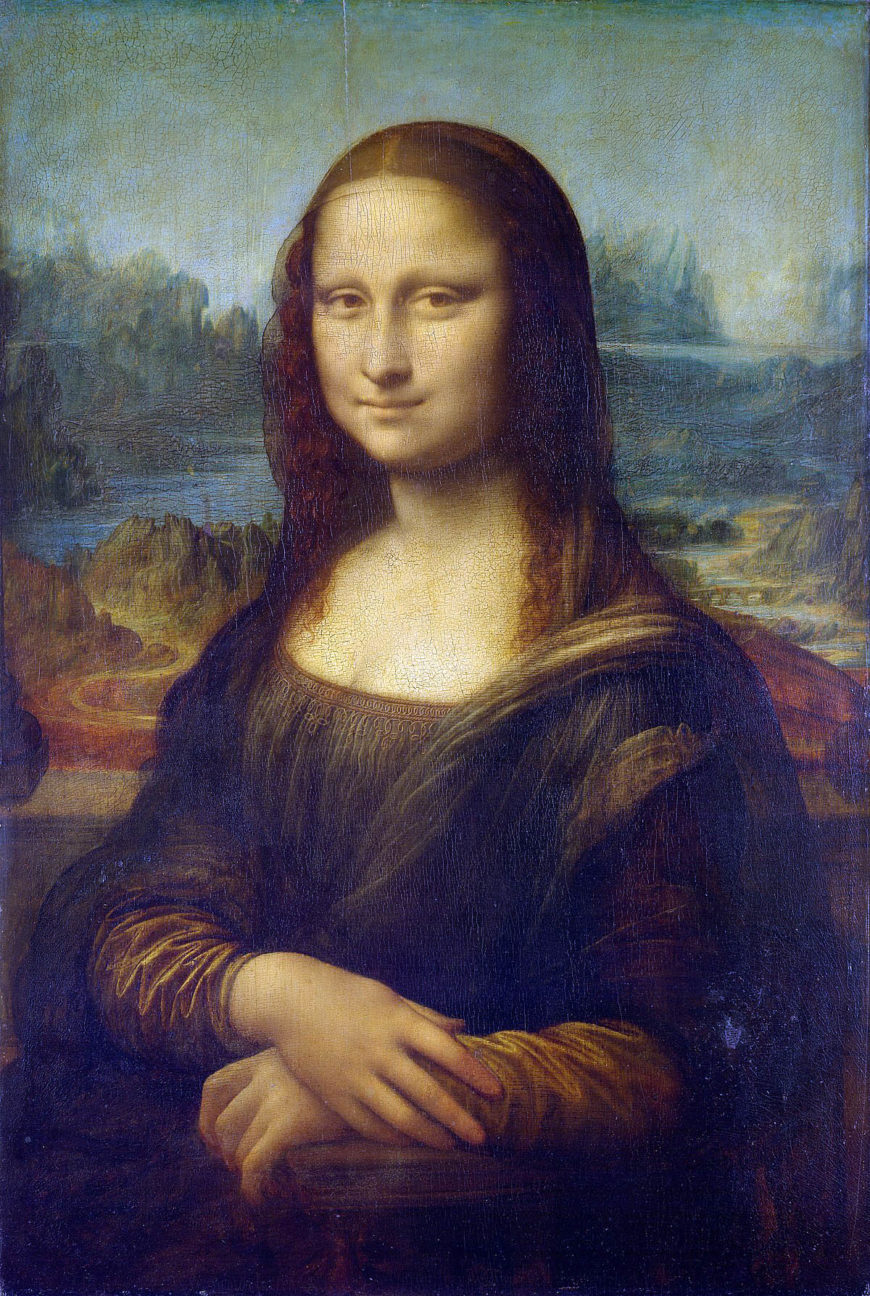
Leonardo da Vinci, Portrait of Lisa Gherardini (Mona Lisa), c. 1503–05, oil on panel, thirty-1/4″ 10 21″ (Musée du Louvre)
Painters from regions north of the Alps created portrait likenesses that turned toward their viewers and appeared to brand eye contact, ultimately inspiring Italian artists, already heavily invested in naturalism, to do the same. In addition, Leonardo da Vinci'due south portraits, too as many of Botticelli's, also began to incorporate more of the torso (consider, for example, how a viewer sees the entire turn of the Mona Lisa ' due south upper body, even the placement of her hands), thereby adding an even greater sense of physical presence to the sitters.
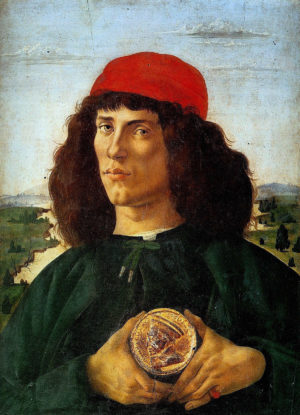
Sandro Botticelli, Portrait of a Man with a Medal of Cosimo il Vecchio de' Medici, c. 1474, tempera on panel, 57.5 x 44 cm (Gallerie degli Uffizi, Florence)
A truly unique portrait
Botticelli's Portrait of a Man with a Medal of Cosimo il Vecchio de' Medici is especially special because it incorporates the "old" format of portraits in its medallion—those in strict profile, meant to reference like objects from antiquity—along with the newly popularized approach that captured more lively and chatty sitters, sitters that make eye contact with their viewers. Hither, Botticelli's beau looks directly out at us, capturing our attention and thereby directing it to what he holds. We feel as though he is speaking to us, asking us to touch this three-dimensional medallion and to recollect his status, amplified by his ties to this important family. The artwork combines former and new, painting and sculpture, to create one of the about unique and enthralling portraits of its time.
Boosted Resource:
This portrait on the Gallerie degli Uffizi website
Read more than about the presentation of self in the Italian renaissance via Italian renaissance learning resources
Why committee artwork during the renaissance?
Types of renaissance patronage
View some other Italian renaissance artwork that uses pastiglia on Smarthistory
Read more well-nigh the Medici as collectors
Francis Ames-Lewis, ed., The Early on Medici and Their Artists (London: Birbeck College, 1995).
Allison M. Brownish, "The Humanist Portrait of Cosimo de Medici, Pater Patriae," Periodical of the Warburg and the Courtauld Institutes, vol. 24, no. iii/4 (1961), pp. 186–221.
Rebecca M. Howard, "A Mnemonic Reading of Botticelli'due south Portrait of a Man with a Medal ," Source: Notes in the History of Art, vol. 38, no. 4 (2019), pp. 196–205.
Richard Stapleford, "Botticelli's Portrait of a Swain Holding a Trecento Medallion," Burlington Magazine, vol. 129, no. 1012 (1987), pp. 428–436.
Source: https://smarthistory.org/botticelli-portrait-man-with-medal/
0 Response to "Portrait of Man Holding Letter Florentine 16th Century Art of Gesu"
Post a Comment